 Patient Login
 (201) 581-6100
Diagnosis Of Peripheral Artery Disease
Peripheral artery disease, also called PAD, is a health condition that decreases blood flow to your limbs due to narrowed arteries in your legs or arms. When fatty deposits accumulate in the arteries, the arteries will become narrow, leading to insufficient blood flow. Early peripheral artery disease diagnosis means you can get proper PAD treatment in the initial stages, which also stops your condition from getting worse.
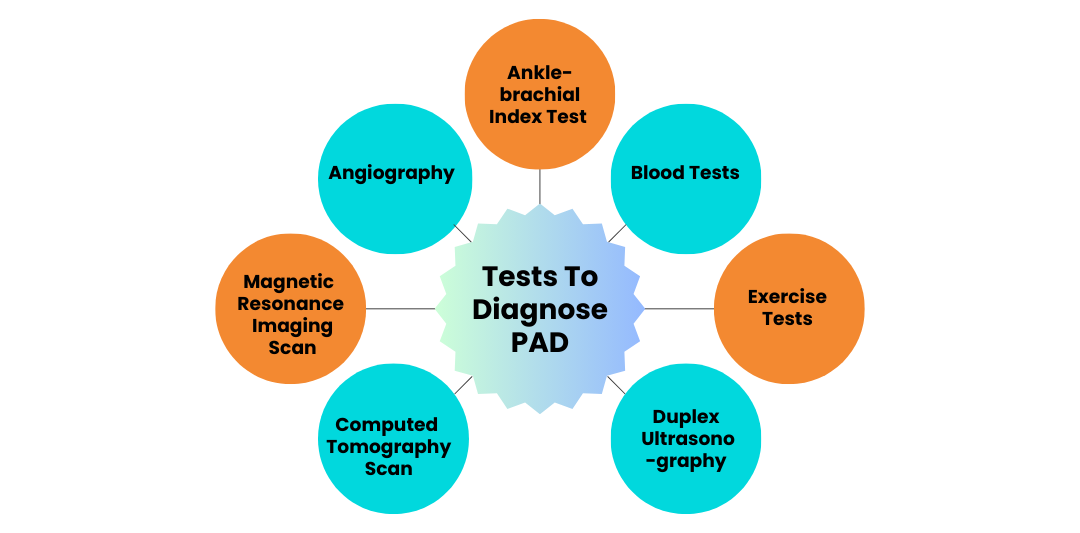
There are various types of tests that are usually conducted by doctors to diagnose peripheral artery disease. Some of the common tests for diagnosing peripheral artery disease are ankle-brachial index test (ABI), blood tests, computed tomography (CT) scan, magnetic resonance imaging (MRI) scan, duplex ultrasonography, and angiography.
What Are The Different Tests Conducted To Diagnose PAD?
1. Ankle-Brachial Index Test
If you exhibit PAD symptoms the doctor is likely to recommend the ankle-brachial index test (ABI), which is one of the most common ways for peripheral artery disease differential diagnosis. This test is conducted in order to check the blood circulation in your limbs, and it will take approximately 10 minutes or even less.
This is a noninvasive test and does not have any side effects. When you are undergoing this test, you need to lie down on a flat surface on your back. Using an ultrasound probe, the healthcare practitioner will note the blood pressure in your arms and ankles.
Your ABI will be determined by calculating a ratio based on the blood pressure values of your arms and ankles. If the ABI value is 0.90 or lower, you are likely to have PAD. If the ABI value is more than 1.3, it indicates that your arteries are stiff and that they might be clogged or not.
2. Blood Tests
Blood tests are also used for peripheral artery disease diagnosis. It is important to note that blood tests alone can not confirm if you are suffering from peripheral artery disease. Instead, they are primarily recommended by doctors in order to know if you have high cholesterol, kidney disease, diabetes, or any other severe health condition.
Blood tests will calculate the levels of cholesterol and triglycerides, which are two main types of fats that usually accumulate as fatty deposits, which commonly leads to peripheral artery disease. In short, blood tests will give a proper idea about your blood sugar levels and elevated blood pressure. This can help your doctor determine whether you have peripheral artery disease or if you are more likely to develop the condition.
3. Exercise Tests
Pulse strength is a type of exercise test that is used as an initial stage diagnosis method for peripheral artery disease. In this test, the healthcare specialist will use a stethoscope to feel your pulse behind the knees, in the groin area, and ankles in order to check the blood circulation.
If there is a damaged or narrowed artery, your pulse will be relatively weak or hard to find. If your arteries have become narrow, it is possible for the physician to hear vascular murmurs as well. Leg-drop tests and leg-elevation tests are also conducted by the doctor to check the blood flow in your lower limbs.
For The Leg-Elevation And Leg-Drop Tests
- You need to lie down on a flat surface on your back
- Raise your legs at an angle of 60 degrees
- Arch and expand your knees for approximately 30 to 60 seconds
- If your foot is receiving less blood flow, then you may feel pain, or your foot will look pale
- Raise your upper body only from the flat surface
- Turn and face the bed’s edge
- Bring your feet down to the floor
- The foot with insufficient blood flow will take a longer time to get redder than the healthy foot
4. Duplex Ultrasonography
Doctors often recommend various types of ultrasound imaging as part of the nursing diagnosis process. These noninvasive tests use sound waves to create detailed images of blood vessels. In the case of peripheral artery disease, ultrasound imaging helps vein specialists visualize the blood vessels clearly and identify any blockages in the arteries.
The duplex ultrasounds utilize B-mode and Doppler technologies to produce images of your blood vessels and show how the blood is circulating within your blood vessels. Ultrasound examinations are occasionally conducted along with a blood pressure cuff. In order to emphasize particular sections of your arteries, the cuff is set on various parts of your leg. This is known as segmental Doppler pressure testing.
5. Computed Tomography Scan
CT scans are minimally invasive tests. To take a CT scan for peripheral artery disease differential diagnosis, contrast dye, and X-rays are used to produce the images of blood vessels in your arteries. CT tests are highly beneficial for people who have stents or pacemakers.
6. Magnetic Resonance Imaging Scan
For peripheral artery disease diagnosis, your doctor also recommends magnetic resonance imaging or MRI scan. Unlike CT scans, MRI scans will deliver cross-sectional images of your arteries. This makes it easy for your doctor to check for any abnormalities in your arteries.
7. Angiography
Angiography is a medical imaging examination that infiltrates a contrast dye into your artery. It utilizes imaging technology in order to develop 3D images of the blood in your arteries in your legs, abdomen, and pelvis.
X-rays are obtained in order to check the blood flow in the arteries and identify any artery blockages. The dye helps healthcare professionals clearly notice how the blood is circulating through the arteries in your limbs.
Steps Toward Better Health Through PAD Screening
If you suspect that you might have peripheral artery disease, it is best to consult a vein specialist like Advanced Medical Group, who will diagnose and recommend the proper PAD treatment depending on the severity of your condition, your medical history, and other factors. Peripheral artery disease diagnosis in the early stages reduces the complications of peripheral artery disease. From ankle-brachial index tests to MRI scans, there are different tests that are carried out for peripheral artery disease nursing diagnosis.