 Patient Login
 (201) 581-6100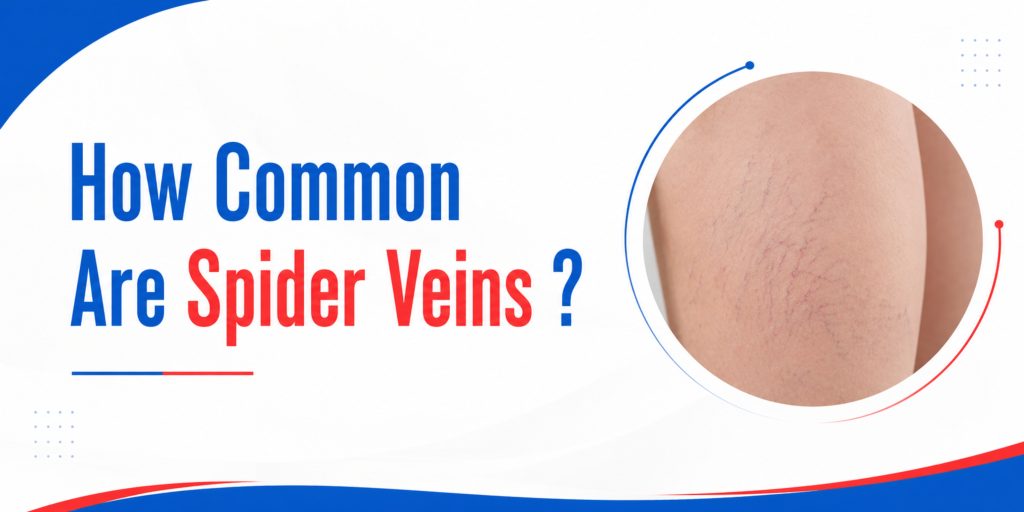
How Common Are Spider Veins? A Look At Who Gets Them And Why
You spotted them last week. A small web of thin red or blue lines on the back of your calf. Maybe a faint patch near the ankle. And now every time you catch yourself in the mirror, that’s where your eye goes.
Here’s the thing. You’re not the only one. Spider veins are far more common than the cosmetic stigma around them suggests, and they show up earlier in life than most people realize. Almost everyone gets them eventually. The only real variable is when.
The better question isn’t whether they’re common. It’s when they appear, who gets them, and what, if anything, they actually mean for your health.
How Common Are Spider Veins Across Every Age Group
Spider veins are a near-universal experience if you live long enough. Clinical research supports that the majority of adults develop at least a few by mid-life. But the age they show up, and the story behind them, differs by decade. Here’s what that actually looks like, age bracket by age bracket.
Spider Veins In Your 20s: More Common Than You Think
If you’re wondering how common are spider veins in your 20s, the honest answer is: more common than social media would have you believe. A meaningful portion of young adults already have visible spider veins by their mid-twenties — they just don’t talk about it.
A few things drive this. Genetics come first. If a parent had them, your odds go up sharply. Hormonal birth control plays a role. So do jobs that keep you on your feet all day, or hunched at a desk for years at a time. Early pregnancies add another layer.
How common are spider veins in young adults? Common enough that noticing a few in your 20s isn’t unusual. It’s just earlier than the cosmetic conversation typically starts.
The 30s And 40s: When They Become A Regular Sighting
Are spider veins common in your 30s and 40s? By this decade, yes. Conspicuously so.
Pregnancy is a major driver for women in this range. The weight of a growing uterus increases pressure on pelvic and leg veins. Hormonal shifts weaken vein walls. Combined, these turn subtle early-stage spider veins into more visible clusters.
Weight gain, sedentary jobs, and years of accumulated standing also compound here. For many people, the 30s and 40s are when spider veins stop being a random curiosity and start being a quiet constant.
After 50: When Most People Have At Least A Few
By the time you reach your 50s, having at least some spider veins is closer to the rule than the exception.
Skin thins. Collagen decreases. Circulation slows. The valves inside your veins lose efficiency. All of this adds up to more visible surface veins over time — especially around the ankles, the backs of the knees, and along the inner thighs.
For some people, it stays purely cosmetic. For others, it’s a signal of changes happening deeper in the vein system, the kind worth a closer look before swelling or skin changes show up.
Why Women Develop Them More Often Than Men
Across every age group, women get spider veins more frequently than men. Estrogen is the main reason.
Hormones across a woman’s lifetime — menstrual cycles, pregnancy, birth control, hormone replacement, menopause — each place different kinds of stress on vein walls. Over decades, that stress adds up. By comparison, men’s hormonal environment is more stable, which is partly why their spider veins tend to appear later and in smaller numbers.
That doesn’t mean men are off the hook. Men who stand all day, smoke, or carry extra weight long-term can develop them just as visibly. The trajectory tends to be slower and less predictable.
The Risk Factors That Actually Matter
Family history is the strongest single predictor. Clinical evidence supports that the vast majority of people with visible spider veins have a close relative who had them too.
Beyond genetics, these are the ones that pile up. Long hours of standing or sitting in the same position. A history of pregnancies. Carrying excess weight for extended periods. Previous blood clots or injuries to the legs. Sun damage for spider veins on the face.
Occupation matters more than most people think. Nurses, teachers, retail workers, hair stylists, and anyone else who logs hours upright without much movement tend to develop them earlier. Some 20-somethings carry every risk factor and have extensive spider veins. Some 60-year-olds have almost none. Genetics aren’t destiny, but they’re a heavy influence.
When They’re Cosmetic vs. When They Signal Something Deeper
Most spider veins are purely cosmetic. They don’t hurt. They don’t swell. They just sit there, doing nothing, bothering no one but you.
But when they’re paired with aching legs, heaviness at the end of the day, burning, itching along a vein, or ankle swelling — that’s a different story. Those symptoms suggest the surface veins you can see are tied to larger vein problems underneath.
That’s the threshold where spider vein treatment becomes a conversation worth having. Not because the lines need to go, but because the underlying circulation may need attention before things progress further.
When Common Becomes Worth A Closer Look
Spider veins are common at every age, in every demographic. But common doesn’t mean identical. Some are a harmless cosmetic feature. Others hint at vein dysfunction that’s worth addressing before it progresses.
How common are spider veins in people like you? Common enough that you’re not alone in wondering, and common enough that spider vein doctors see a wide range of patients across every age bracket. Advanced Medical Group offers evaluations that clarify whether what you’re seeing is purely cosmetic or part of a larger circulation picture. Either way, you walk out with a clearer answer than the mirror alone can give you.