 Patient Login
 (201) 581-6100
Smoking And PAD A Dangerous Link To Disease Progression
Do you know that smokers are 4 times more likely to develop PAD as compared to nonsmokers? Even more unbelievable, nearly 80% of the underlying cases of PAD can be accounted for by smoking.
PAD is a condition that, through narrowing the arteries, generally in the legs, reduces blood flow to your limbs. This is a silent yet serious condition that can result in severe complications if left untreated. While many factors contribute, smoking is by far among the most significant factors that aggravate PAD. The relationship between smoking and PAD is not only that of risk but also where the rate of disease progression is directly influenced, along with the challenge in its management.
In this blog, we will look into how smoking affects PAD and influences the course of the progression of PAD and can even make the difference between saving or losing a limb.
How Smoking Promotes The Development Of PAD?
The link between smoking and PAD cannot be hidden, as we have seen. What is even worse, however, is that the fact that smoking increases the chances of acquiring the disease is one thing, but accelerating it is another story altogether.
Here’s how smoking affects PAD:
1. Accelerates Arterial Damage
Smoking fills your body with bad chemicals, such as nicotine and carbon monoxide. These chemicals directly damage the coating of your arteries and weaken them, thus, hastening and stiffening them. This, in turn, accelerates the progression of PAD. You can think of blood vessels as flexible rubber tubes; cigarette smoking turns them into inflexible straws that cannot function correctly and deliver smooth blood flow. Effective PAD treatment involves protecting your arteries.
For instance, a smoker with PAD may notice their walking distance shrinking due to leg pain caused by reduced blood flow. This isn’t just discomfort—it’s your arteries signaling distress.
2. Increases Blood Clot Risk
Smoking makes your blood more likely to form clots, which can further clog narrowed arteries. Think of trying to drive through a tunnel that’s not only narrow but also full of debris. Blood clots in people with PAD can lead to severe results, such as heart attacks or strokes.
A 50-year-old smoker with periodic pain in the legs-suddenly, for example,-might experience sudden pain or increased numbness in their extremity. This is simply due to a clot cutting off circulation, necessitating immediate medical attention.
3. Reduces The Delivery Of Oxygen
Carbon monoxide in cigarette smoke robs your muscles, brain, and body tissues of the oxygen they need. This is a double whammy for people with PAD. Their limbs are already being starved of blood, and now that blood carries less oxygen. What that does is starve the muscles. Activities, such as climbing stairs or simply walking to the grocery store, become exhausting.
Imagine walking up a hill carrying groceries. For a PAD patient who smokes, this means carrying twice that weight because their muscles aren’t getting the oxygen they require.
4. Worsens Circulatory Problems
Smoking not only narrows arteries but also worsens overall circulation by increasing heart rate and blood pressure. Poor circulation in PAD patients can lead to cold or numb feet, cramps, and even ulcers.
Picture someone sitting in their office all day, only to find their legs cramping or their feet freezing even in warm weather. This isn’t just an annoyance—it’s a sign that their circulation is compromised.
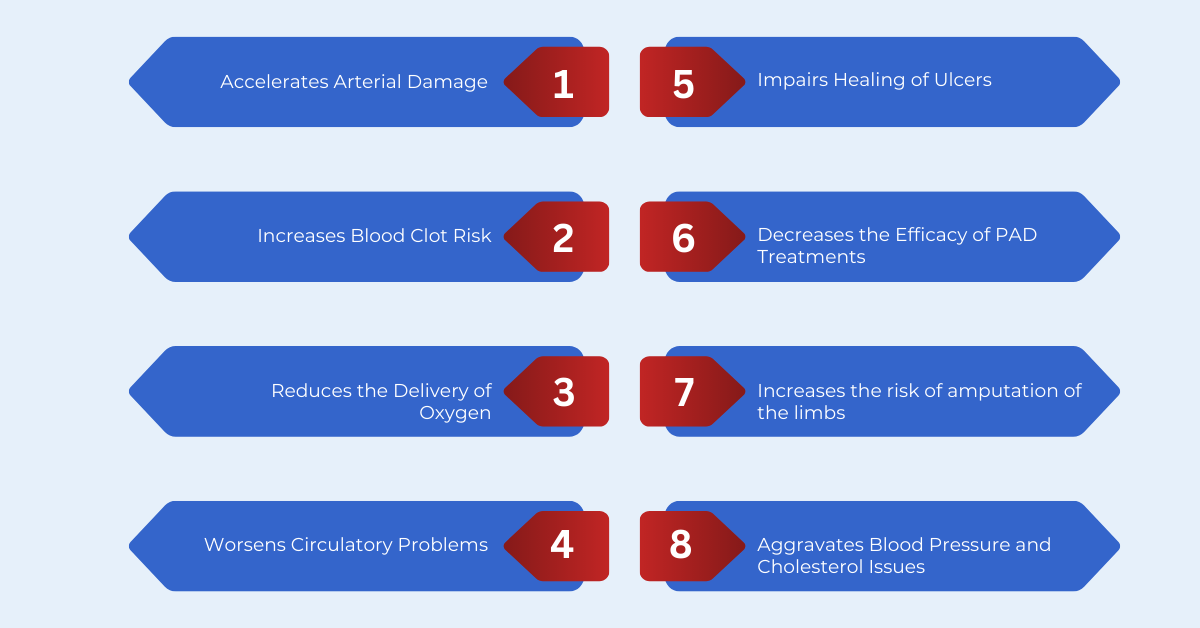
5. Impairs Healing Of Ulcers And Wounds
PAD already delays the process of wound healing because of the limited flow of blood, and smoking makes it worse. Nicotine further restricts blood vessels, which impedes the process of wound healing by preventing the necessary nutrition and oxygen from reaching the wound site.
For example, a smoker having a small cut on his foot may experience weeks and even months to heal. This, in turn, leads to the development of infection and further serious complications.
6. Decreases The Efficacy Of PAD Treatments
Peripheral artery disease treatments include the use of medications, lifestyle modification, and surgery, as well as improved blood flow and reduced symptoms. However, tobacco usually works against the treatments in place. For example, medications that can lower one’s blood pressure or cholesterol are less effective in smokers.
A patient who has undergone some form of PAD treatment or surgery and continues to indulge in smoking may hardly make their symptoms improve; even frustratingly, they feel much worse, thus compelling additional PAD treatment costs.
7. Increases The Risk Of Amputation Of The Limbs
More serious forms of PAD involve insufficient blood supply that can be severe enough to cause tissue death and necessitate amputation. Smoking exacerbates the condition through further constriction of flow and impediments to healing.
For example, a patient with PAD who continues to smoke and then develops a non-healing wound of the foot will have a greatly reduced chance of limb salvage if he does not stop smoking. Stopping might allow for improvement in perfusion and spontaneous healing of the wound.
8. Aggravates Blood Pressure And Cholesterol Issues
Smoking raises blood pressure while lowering good cholesterol, or HDL, a near-perfect storm for the perpetuation of PAD. For a person with high blood pressure, it puts a great amount of additional tension on already narrowed arteries, whereas low HDL cholesterol implies less protection against plaque that might build up.
A smoker with PAD may be seeing his or her PAD treatment doctor continually adjusting medications. At the same time, the underlying factor (which, in this case, is smoking) is not resolved, which complicates managing these risk factors.
Prioritize Your Health By Quitting Smoking To Better Manage PAD
One of the worst things a person with Peripheral Artery Disease can do is smoke. It accelerates the damage in the arteries, raises risks for blood clots, and makes every single facet of PAD—from circulation to wound healing—worse.
Quitting is not just a recommendation but an important intervention in trying to slow the progression of the disease and improve overall health. It is never too late to seek help for yourself or your loved one in the fight against PAD and smoking.
PAD treatment specialists like those at Advanced Medical Group will be able to lead you through effective peripheral artery disease treatments while helping you to stop smoking. With this change, complications can be reduced, quality of life improved, and it may just save a limb—or your life.
Remember, every step toward quitting smoking is a step toward better health. Make today the day you choose to fight PAD head-on.