We are now open every Saturday! Visit our WEST NEW YORK Location for a weekend appointment.
WE OFFER FREE INSURANCE VERIFICATION (CALL 201-581-6120)

We are open and safely seeing patients

* Advanced Medical Group is excited to offer weekend(Saturday) cardiology services in Jersey City * * Advanced Medical Group is excited to offer weekend(Saturday) cardiology services in Jersey City * * Advanced Medical Group is excited to offer weekend(Saturday) cardiology services in Jersey City * * Advanced Medical Group is excited to offer weekend(Saturday) cardiology services in Jersey City * * Advanced Medical Group is excited to offer weekend(Saturday) cardiology services in Jersey City* * Advanced Medical Group is excited to offer weekend(Saturday) cardiology services in Jersey City* * Advanced Medical Group is excited to offer weekend cardiology services in Jersey City* * Advanced Medical Group is excited to offer weekend(Saturday) cardiology services in Jersey City*

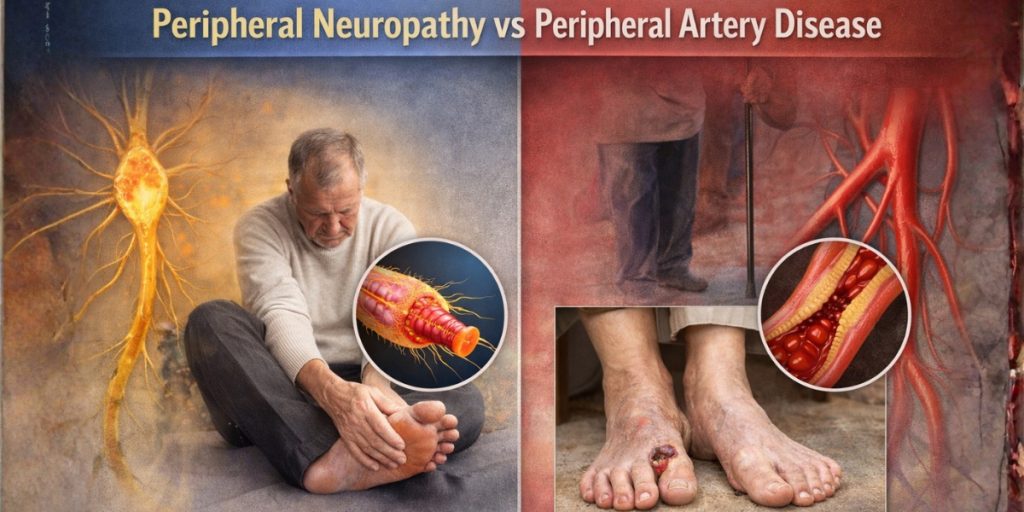
Peripheral Neuropathy vs Peripheral Artery Disease

peripheral neuropathy vs peripheral artery disease

Key Differences And Health Impacts Of Peripheral Neuropathy vs Peripheral Artery Disease

Have you been experiencing pain, numbness, tingling, or weakness in the legs? If so, your first instinct might be to do a quick Google search for it.

If you do that, you are likely to come across two medical conditions called peripheral neuropathy and peripheral artery disease. Both conditions affect similar areas of the body, particularly the legs and feet. And some of their symptoms appear similar at first.

However, despite the surface similarities, these are two fundamentally different conditions. Without a clear understanding of peripheral neuropathy vs peripheral artery disease, it’s easy to be confused.

Peripheral neuropathy involves damage to the nerves. It affects how signals are sent and received. Peripheral artery disease is a circulatory disorder. It occurs when plaque builds up in the arteries and reduces blood flow.

Since the underlying problem is different, how each condition is diagnosed and treated also varies significantly.

Peripheral Neuropathy vs Peripheral Artery Disease Differences

Because of their overlapping symptoms, people, even healthcare professionals, often initially misdiagnose PAD for peripheral neuropathy or vice versa.

It’s also crucial to understand how these two conditions differ to avoid any confusion. So, here, we’ll give you an overview of peripheral artery disease vs peripheral neuropathy.

1. Underlying Disease

Peripheral artery disease and peripheral neuropathy affect different systems. And this difference affects how and what symptoms appear and what PAD treatment is pursued.

Peripheral Artery Disease:

Also called PAD, peripheral artery disease occurs because of the narrowing or blockage of the arteries that supply blood to the legs. It happens due to atherosclerosis, which is when fatty deposits build up inside the artery walls.

Over time, this limits blood flow. When this happens, muscles get tired quickly during activity. In advanced stages of the condition, muscle fatigue and pain may occur even at rest.

Peripheral Neuropathy:

Peripheral neuropathy occurs when the nerves outside the brain and spinal cord, also known as peripheral nerves, are damaged. These nerves carry signals related to sensation, movement, and automatic functions like temperature control or sweating.

When they get damaged, these signals may be delayed, distorted, or lost altogether. That’s why peripheral neuropathy often produces abnormal sensations. It doesn’t necessarily cause pain during physical exertion.

2. Physical Changes In The Legs And Feet

A physical examination may also reveal signs of one or the other condition.

Peripheral Artery Disease:

PAD can cause visible and measurable changes in the legs and feet. Skin may appear pale or bluish. It may feel cool to the touch or become thin and shiny over time.

Hair growth on the legs may decrease. Pulses in the feet may be weak or absent, reflecting reduced blood flow. Cuts or sores may heal slowly, or not at all, due to inadequate circulation.

Peripheral Neuropathy:

In neuropathy, the skin often appears normal, but sensation is altered. You may not feel temperature changes, pressure, or pain as expected.

Muscle weakness and balance issues can develop. It happens especially if the motor nerves get damaged.

peripheral artery disease vs neuropathy

3. Signs and Symptoms

On the surface, some PAD symptoms may appear similar to those of neuropathy. That’s what often causes people to confuse the two conditions.

Peripheral Artery Disease:

The symptoms associated with PAD are caused by reduced blood flow. The most common symptom is leg pain or cramping that occurs when walking and eases when resting. This pattern is also known as intermittent claudication.

Other common symptoms of PAD are a feeling of heaviness in the legs, coldness in the feet, changes in skin color, or wounds that heal slowly due to poor circulation.

Peripheral Neuropathy:

Neuropathy symptoms are more sensory in nature and not based on activity. That’s the main takeaway in the differences of symptoms in PAD vs neuropathy.

Those with this condition may experience tingling, burning, or stabbing sensations. A lack of sensation or numbness is also a symptom. These symptoms often worsen at night and may persist even when resting.

Because of the impaired sensations, afflicted individuals may not realize when there’s a minor injury in the area. That becomes a problem over time.

4. Pattern And Timing Of Pain

When discussing the symptoms, it’s just as important to talk about when these symptoms appear.

Peripheral Artery Disease:

The pain associated with PAD usually follows a predictable pattern. It typically develops during physical activity such as walking or climbing stairs. The pain goes away after a short period of rest.

It happens because the muscles in the area require more oxygen during activity. And they don’t get that because of the poor blood flow. When circulation catches up while resting, the pain subsides.

In more advanced stages of PAD, pain may appear even during inactivity. That indicates a more severe blood flow issue.

Peripheral Neuropathy:

Neuropathic pain does not depend on the level of activity. It may appear suddenly, linger without a clear trigger, or worsen during periods of inactivity. The pain may get worse at night.

It happens when the damaged nerves misfire or cannot regulate sensory signals properly.

5. Risk Factors And Triggers

Both conditions share some risk factors. But how those risks affect the body is significantly different in peripheral artery disease vs neuropathy.

Peripheral Artery Disease:

Everything that can damage the blood vessels over time is a risk factor for PAD. Smoking, high cholesterol, high blood pressure, and aging can all contribute to the narrowing of the arteries.

Diabetes can also accelerate vascular damage. It makes arteries stiffer and more prone to plaque buildup. A sedentary lifestyle can further compound these effects by reducing the overall efficiency of blood circulation.

Peripheral Neuropathy:

Anything that can damage the peripheral nerves is a risk factor for neuropathy. Diabetes is again a major contributor. However, in this case, the elevated blood sugar levels damage nerve fibres.

Chronic alcohol use, vitamin deficiencies, autoimmune disorders, and infections are also common triggers. It may even be caused as a side effect of certain medications.

6. Diagnostic Evaluation

To get an accurate diagnosis, a doctor will prescribe specific tests. These tests produce results that are not interchangeable.

Peripheral Artery Disease:

To diagnose PAD, doctors focus on blood flow. A common test is the ankle-brachial index. It compares the blood pressure in the ankle to the blood pressure in the arm.

Lower readings in the ankle indicate poor blood flow to the legs. A doctor may also prescribe imaging studies such as a vascular ultrasound or angiography.

It is necessary to visualize the narrowing or blocked arteries and how severe the condition is.

Peripheral Neuropathy:

To detect neuropathy, a doctor may prescribe nerve conduction studies. The test measures how quickly electrical signals travel through the nerves. Slowed or weakened signals could mean nerve damage.

Electromyography is another common test. It evaluates how muscles respond to nerve signals.

peripheral artery disease vs peripheral neuropathy

Finding The Right Treatment For Both Conditions

After getting an accurate diagnosis, it’s necessary to get on the best treatment plan. Since the treatment for each condition varies wildly, you must seek experts.

At Advanced Medical Group, you will find the best treatment for PAD. With decades of experience under their belt, the doctors here successfully treat PAD.
Book an Appointment

Popular Blogs

One Click Towards Healthy Life Medical Group Right arrow

Book Appointment

Request The Call Back

Fathima

Fatima Shaik MD

Cardiologist

Fatima Shaik is a board certified internist and cardiologist. She specializes in general cardiology and heart rhythm disorders. She cares for patients at Advanced Medical Group in Jersey City and North Bergen. She also performs procedures at Jersey City Medical Center.

She completed her undergraduate education at NYU and received her MD degree for SUNY Downstate Medical Center. She completed her residency training at Mount Sinai Beth Israel Medical Center and her cardiology fellowship at New York Presbyterian Queens. She went on for advanced training in electrophysiology at Cooper Hospital in Camden, NJ.
She is trained in device implantation, SVT and atrial fibrillation ablations as well as watchman implantations.
She is fluent in English and Hindi.
She is currently accepting new patients.

Reema Parikh, DPT

Physical Therapist

Reema Parikh received two bachelor’s degrees from Long Island University and Touro College, and graduated as a Doctor of Physical Therapy from Touro College in 2013. In her early years as a DPT, she received an award for excellence in research and taught a course for the national physical therapy licensing board exam. Dr. Parikh has a passion for helping patients on their health journey; she is experienced in all ages and care of patients, ranging from pediatric care to geriatric care. She has hosted live and virtual workouts for varying levels of physical activity, incorporating mobility and strength segments. Dr. Parikh has furthered her education by receiving certifications in many aspects of physical therapy and holistic care including Nutritional PT, Restorative Yoga, Pilates, and Reiki.

Maria-Avila

Maria Avila, NP

Nurse Practitioner

Coming Soon

Location

Jersey City

Union City

West New York

North Bergen

Jersey City

North Bergen

Dr. Parab

Aishwarya Parab, PT

Physical Therapist

Aishwarya Parab received her Bachelors in Physiotherapy in India in 2015 and furthered her studies at Long Island University where she graduated with her Masters in Exercise Science, Sports, and Nutrition in 2019. She has experience working with various conditions, including herniated disks, spondylolysis, and post-operative mobility issues. Aishwarya has taken courses to expand her knowledge in the physical therapy world, including spinal mobility courses, neuromuscular reeducation courses, and getting a certificate with Revolution in Motion. Aishwarya finds it exceedingly rewarding to build a long-term relationship with her patients and shows commitment towards providing structured and effective healthcare.

Dr. Prajakta Avhad

Prajakta Avhad, MD

Pain Management located in Franklin Township, Somerset, NJ & East Brunswick, NJ

About Dr. Avhad
Dr. Prajakta Avhad is double board-certified in Pain Management and Anesthesiology. Dr. Avhad received her M.B.B.S. from MIMER, India, and completed her Surgical internship and Anesthesia residency at Brookdale University Hospital in Brooklyn, New York during which she interned at Memorial Sloan Kettering, St. Luke’s Roosevelt, and Staten Island Hospital.

She then completed her Pain Management Fellowship from Cleveland Clinic Foundation.

Dr. Avhad is a diplomate of the American Board of Anesthesiology and a member of the American Academy of Pain Medicine.

Dr. Avhad has been in practice in Central and South Jersey for more than 12years. She is a caring physician with expertise and experience in treating a spectrum of Pain conditions like chronic back and neck pain, herniated discs/sciatica with minimally invasive interventional procedures.

Dr. Avhad and her family reside in New Jersey. She is an avid gardener active with her kids, dog, and garden if not tending to her broad and exotic orchid collection.

Radhika Patel PA-C

Radhika Patel, PA-C

Physician Assistant located in Jersey City, NJ

About Patel
Graduating summa cum laude from Rutgers University with a BA in Biological Sciences and minor in Spanish, Radhika Patel obtained experiences in outpatient medicine as well as in emergency medical services prior to pursuing a career as a physician assistant. She graduated from the Rutgers University Physician Assistant program with a Master of Science after training in cardiology, internal medicine, and urgent care, among many other fields at various hospitals and private practices throughout the state of New Jersey. She is a proud member of the team at Advanced Garden State Cardiology and looks forward to meeting with patients each day in our Jersey City office.

Enrique D Chappilliquen Lucio, PA-C

Enrique Chappilliquen, PA-C

Physician Assistant located in Union City, NJ & Jersey City, NJ

About Dr. Chappilliquen
Graduated from Mercy College Physician Assistant Program with a Masters of Science in Physician Assistant Studies, Enrique has extensive experience in the medical field for more than 6 years.

He has clinical experience and training in internal medicine, cardiology, general and vascular surgery, hematology, oncology, and emergency medicine. He joined Dr. Richard’s practice in October of 2016. Since then, he has been a dedicated medical provider working in the Union City office and the Hematology/Oncology office in Jersey City as well.

As a Hispanic, he proudly serves his community with passion and devotion. Being able to communicate fluently with his patients allows him the opportunity to provide excellent medical care to the Hispanic community in Union City and Jersey City. Also, sharing the same language, culture, and values as his patients allows him to connect at a personal level with his patients. Enrique continues to develop his knowledge and skills constantly to continue satisfying the needs of his patients.

Dr Christopher Samaniego, DPM

Christopher Samaniego, DPM

Podiatrist located in Jersey City, NJ, Union City, NJ, and West New York, NJ

Christopher Samaniego, DPM, is originally from Freehold, New Jersey. He attended college at Messiah College, where he graduated Magna Cum Laude with a degree in Biology. He earned his podiatric medical degree from Temple University School of Podiatric Medicine in Philadelphia, PA and completed his surgical residency training at Detroit Medical Center in Detroit, MI. 

Dr. Samaniego provides comprehensive foot and ankle care at Advanced Medical Group in Jersey City, Union City, and West New York. His specialized surgical training includes

  • Bunion
  • Hammertoe correction
  • Diabetic foot care
  • Fungal nail care
  • Plantar fasciitis, tendinitis, orthotics
  • Gout, warts, neuroma care
  • Flat feet and high arched feet
  • Foot and ankle trauma
  • Adult and paediatric foot conditions
  • Arthritis of the foot and ankle
  • Arthroscopy, joint replacement, minimally invasive techniques

Samaniego is a member of the American College of Foot and Ankle Surgeons and the American Podiatric Medical Association. He keeps up to date on the latest surgical techniques and available technology in foot and ankle care.

Prior to joining Advanced Medical Group, Samaniego studied public healthcare in Zambia and assisted in providing care to the local community. He has also presented research at the annual meeting of the American College of Foot and Ankle Surgeons. Samaniego achieved the highest rank of Eagle Scout through the Boy Scouts of America and volunteered with Troop 454 for scouts with special needs and the Freehold Public Library. In his free time, Samaniego volunteers with his local church community service and youth programs.

Samaniego resides in Jersey City, NJ and maintains his health by cycling and interval training several times a week. He explains, “Healthy doctors inspire healthy patients. I follow the same advice I give my patients, and I read constantly to become a better physician every day. I encourage my patients to ask questions and learn about the cause of their symptoms. An ounce of prevention is worth a pound of cure.”

Dr. Merwin Richard, MD. A cardiologist

Merwin Richard, MD

Cardiologist located in Jersey City, NJ & Union City, NJ

As an established board-certified internist and cardiologist, Merwin Richard, MD, has a reputation for helping patients with the most complex of health conditions. He cares for patients at Advanced Medical Group in West New York, Jersey City, and Union City, New Jersey.

Richard began his undergraduate education in medicine at Stanley Medical College in India. He earned his doctor of medicine degree from Tamil Nadu Dr. M.G.R. Medical University before relocating to New York City.

After completing both his internship and internal medicine residency through the Albert Einstein College of Medicine, Dr. Richard went through advanced fellowship training. He completed a cardiovascular fellowship at Columbia University College of Physicians and Surgeons, then went on to finish a second fellowship in interventional cardiology through Mount Sinai School of Medicine (now Icahn).


Throughout his career, Richard has stayed involved in numerous research projects and previously served as a professor at the University of Medicine and Dentistry of New Jersey (now Rutgers University). Richard went on to become the director of the first cardiac catheterization and interventional laboratory in Jersey City and has extensive training in vein treatments.

To ensure he continues staying up to date with the latest research and techniques, Richard maintains his board memberships. He’s board certified through the American Board of Internal Medicine in cardiovascular disease and interventional cardiology.

Being fluent in English,  Spanish, and Tamil gives Richard the opportunity to communicate with patients from diverse cultural backgrounds. Richard is currently accepting new patients.

Advanced Medical Group
Privacy Overview

This website uses cookies so that we can provide you with the best user experience possible. Cookie information is stored in your browser and performs functions such as recognising you when you return to our website and helping our team to understand which sections of the website you find most interesting and useful.