Leg Pain & Claudication

Leg pain that finally has a fix

Cramping, aching or heaviness when you walk — relieved when you rest — is rarely “just getting older.” It’s usually claudication, and it has a real fix.

Leg Pain & Claudication care at Advanced Medical Group
Overview

Why your legs hurt when you walk

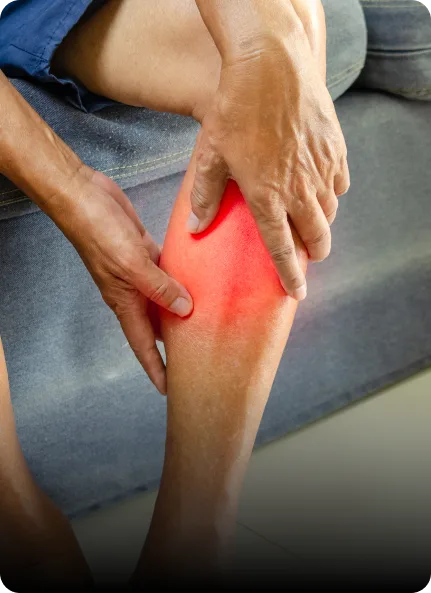
Intermittent claudication is leg pain caused by reduced blood flow during exertion. When the muscles in your calves, thighs or buttocks demand more oxygen — like during a walk up a hill — narrowed arteries cannot keep up, and you feel cramping or fatigue that forces you to stop.

The give-away pattern is predictability: pain comes on at roughly the same walking distance, eases within a few minutes of standing still, and returns when you start again. Catch it early and a combination of supervised walking, medications, and (when needed) a minimally invasive procedure can usually restore comfortable walking.

Book a Consulting →

Minimally invasive, in-office diagnostics and procedures — no hospital stay.

Care led by a board-certified interventional cardiologist, not a generalist.

Endocrinology, vascular and wound care under one roof — one plan, not five referrals.

Same-week new-patient appointments across five Hudson County locations.

Insurance verified before your visit — no billing surprises.

Our Team

Specialists who treat this condition

A small, senior team — board-certified cardiology, vascular, podiatry and endocrinology — sharing one chart and one plan.

Meet all providers →
Why Choose Us

Why patients choose Advanced Medical Group

Coordinated, specialist-led vascular care — in five Hudson County locations, close to home.

Specialist-led care
In-office OBL
Same-week appointments
Coordinated care team
Minimally invasive
Insurance concierge
Know the Signs

Symptoms & risk factors

If two or more of these apply to you, a baseline vascular evaluation is one of the highest-yield prevention steps you can take.

Symptoms to watch for

Listen to your body

  • Reproducible cramping or aching in calves while walking
  • Pain in thighs, hips or buttocks during exertion
  • Symptoms always ease within 2–5 minutes of standing still
  • Walking distance that has shortened over weeks or months
  • A sense of leg fatigue or heaviness before pain begins
  • Difficulty walking up inclines or stairs
  • Occasional weakness in one leg compared to the other
Risk factors

Conditions that raise your odds

  • Smoking — the single strongest risk factor
  • Diabetes (especially long-standing)
  • High cholesterol or high blood pressure
  • Age 65+ or 50+ with one other risk factor
  • Sedentary lifestyle
  • Known heart disease or prior stroke
  • Chronic kidney disease
Treatment Process

From first visit to long-term protection

A predictable four-step path — no guesswork, no months of waiting between appointments.

  1. Step 01

    Evaluation & Imaging

    Vascular exam, ABI and on-site imaging — usually completed in one visit.

  2. Step 02

    Personalized Care Plan

    A coordinated written plan tailored to your anatomy and goals.

  3. Step 03

    In-Office Procedure

    Minimally invasive treatment in our OBL, under local anesthesia.

  4. Step 04

    Follow-Up & Prevention

    Structured follow-ups, surveillance imaging and risk-factor coaching.

FAQ

Common questions

Real, specific answers from our team. If your question is not here, our front desk can usually answer it in a 5-minute phone call.

Is claudication dangerous?

On its own it is rarely an emergency, but it is a strong warning sign that the same plaque is narrowing arteries in your heart and brain. Diagnosing and treating claudication reduces your risk of heart attack and stroke.

Will I have to give up walking?

The opposite. Supervised walking is one of the most effective treatments — it stimulates new small vessels to grow around the blockage. We build a program that meets you where you are.

How is it different from arthritis pain?

Arthritis usually hurts in the joints and is worst when you first start moving. Claudication hurts in the muscles, comes on after a predictable distance, and reliably stops when you rest.

When is a procedure needed?

When the pain limits your daily life, is getting worse, or when you have an ulcer that will not heal. Many patients are well controlled with medication and exercise alone.

Is the angioplasty painful?

You feel the local anesthetic at the small wrist or groin puncture site. The procedure itself is felt as gentle pressure and is usually well tolerated. You go home the same day.

How long until I can walk farther?

After successful angioplasty, many patients double their walking distance within a few days and continue improving over weeks as fitness returns.

Testimonials

Stories from patients we have treated

Names changed where requested. Every quote below comes from a patient seen at one of our Hudson County locations.

★★★★★

“I had given up the dog walks I love. Three weeks after the procedure I was back to a mile a day, pain free.”

Marcus T. North Bergen
★★★★★

“Cardiology, vascular and physical therapy all in one place meant I actually completed the plan instead of bouncing between offices.”

Diane V. Jersey City
★★★★★

“I thought it was just my age. Turns out a 30-minute test caught a blockage we could fix in an afternoon.”

Robert E. Union City
Get Started

Walk farther, with less pain

A 30-minute vascular check tells you exactly what’s causing the pain — and what to do about it. Covered by Medicare and most commercial plans.

Same-week appointments · Five Hudson County locations · Medicare & most commercial plans accepted

Advanced Medical Group
Privacy Overview

This website uses cookies so that we can provide you with the best user experience possible. Cookie information is stored in your browser and performs functions such as recognising you when you return to our website and helping our team to understand which sections of the website you find most interesting and useful.